Home / The Journal / Lip Care
The Ultimate Guide to Lip Balm in New Zealand
Mollie’s Balm Co. · 3 November 2026 · 10 minute read
A good lip-care routine should be easy to live with. It should fit into an ordinary morning, travel comfortably in your bag, and help you make sensible choices when the weather changes. It does not need a succession of flavours, a different product for every hour, or promises about perfect lips. Start with a lip balm that feels comfortable, understand what it is intended to do, and keep sun protection as a separate, deliberate consideration.
In New Zealand, “everyday” can mean a windy commute, a sunny lunch break and a heated room in the same day. This guide brings the buying decision and the routine together. It explains how to compare formulas and formats, what to check on a label, and how Mollie’s four lip balm choices fit within that picture. The aim is useful care rather than an increasingly complicated collection.
First decide what you expect from lip balm
A conditioning lip balm is a cosmetic product for the lips. It can offer a comfortable, softening layer and a finish you enjoy wearing. Those are reasonable reasons to use it. They are different from expecting it to diagnose the cause of dryness, treat a persistent problem, or provide sun protection without an appropriate SPF claim. Keeping the job clear makes the product easier to assess and helps you recognise when you need something other than another application.
Think about your own preferences before looking at flavour names. Do you want no added fragrance? Would you rather apply directly from a tube, or use a tin when clean hands are available? Do you like a light application during the day and a more noticeable finish at home? These are practical preferences, not measures of how seriously you take skin care. A product you can use comfortably and consistently is more useful than one selected for an impressive description alone.
What dry-feeling lips are asking you to review
Dry-feeling lips can make people focus entirely on the product in their pocket. It is worth looking at habits and surroundings too. The American Academy of Dermatology identifies weather, sun exposure and frequent lip licking among reasons lips can become chapped. It advises stopping products that cause discomfort rather than interpreting stinging as a sign of effectiveness. Its guidance on dry, chapped lips is a helpful reference when ordinary lip care is no longer comfortable.
Make the review simple. Have you recently changed lip products? Are you repeatedly licking or picking at your lips? Are you treating a windy outdoor day as if it were a quiet day inside? Observing these details does not establish a diagnosis, but it gives you better questions to ask. If a problem persists, worsens or concerns you, seek a health professional’s advice. Do not use a cosmetic guide to explain away symptoms you would otherwise have checked.
Conditioning and sun protection need separate labels
A balm’s texture, colour or botanical content does not tell you its SPF. If a product does not carry an appropriate sun-protection claim, do not assume that it protects against ultraviolet radiation. Mollie’s Lip Balms are presented as conditioning products, with no SPF claim in the supplied product information. Enjoying one does not remove the need to plan appropriate outdoor protection. Choose a separately labelled lip sun-protection product and follow its directions when that is the job required.
New Zealand’s SunSmart guidance explains that UV cannot be judged by how warm a day feels, and recommends protection when the UV Index reaches 3 or more. That makes the forecast and the planned activity more useful than the season alone. See SunSmart’s explanation of UV radiation for the local context. A cool spring afternoon can still deserve a deliberate sun-care plan.
Keep the two roles clear in your bag as well as in your mind. A familiar conditioning tube is easy to reach for automatically, so check that the product you use for outdoor protection is the one with the relevant label. Do not mix products together or assume that adding a layer of ordinary balm preserves another product’s performance. Follow the sunscreen product’s instructions and choose a routine that makes those instructions easy to follow.
Read the exact flavour's ingredient list
A shared brand name does not mean every lip balm has an identical ingredient list. Original and flavoured versions need to be read individually. If you know that an ingredient does not suit you, the full list is more important than the size of the word “natural” on the front. If you cannot find the information you need, contact the maker before buying. Asking a clear question is a better shortcut than assuming a familiar flavour tells you the formula.
Ingredient education can help you understand the product without turning shopping into homework. Oils, butters and waxes can contribute different aspects of a balm’s feel, but the finished formula determines the experience. Our guide to natural balms explains the broader comparison. Use that background to ask informed questions, while keeping the individual product label as your reference for what is actually present.
Original, Vanilla, Strawberry or Coconut?
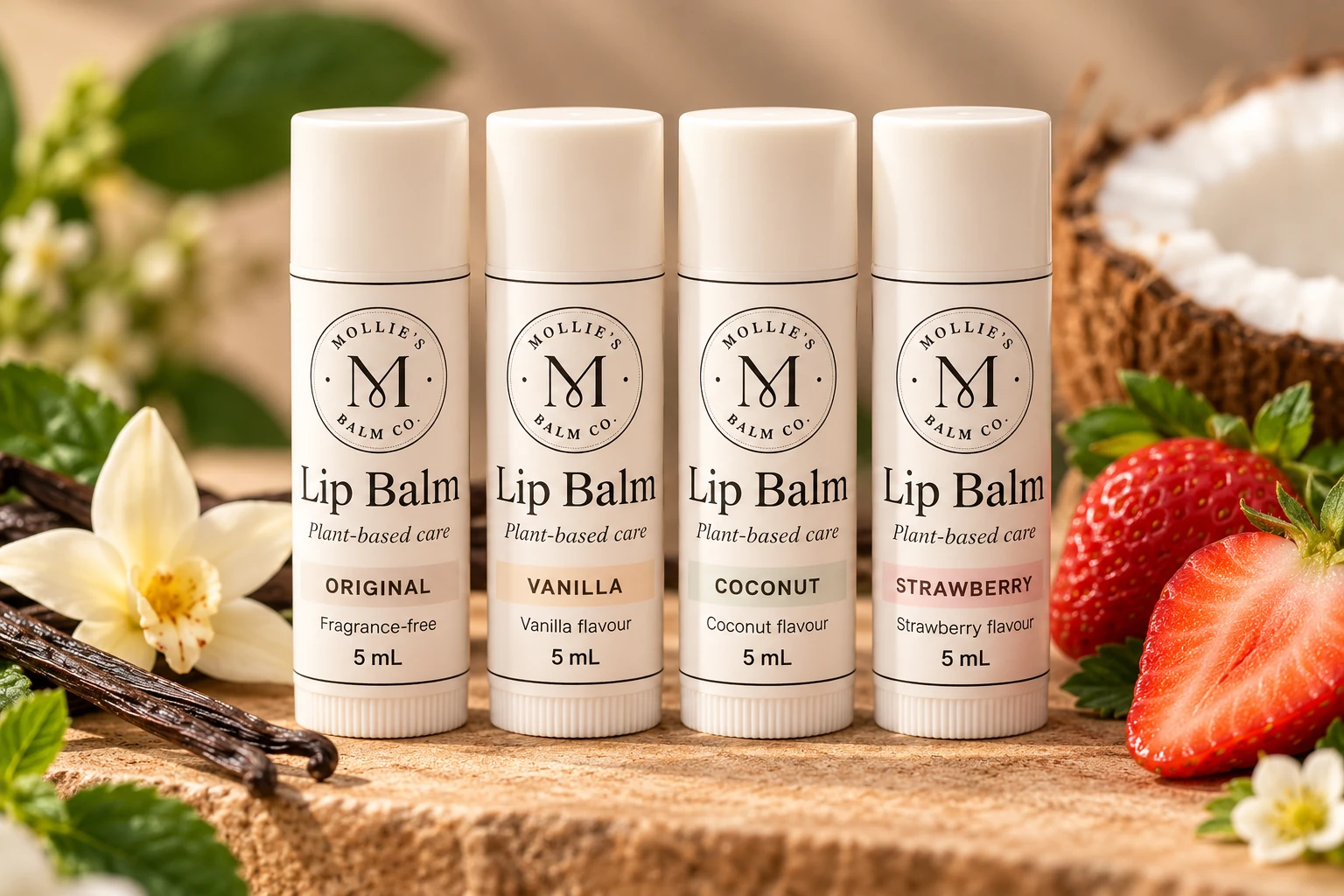
Mollie’s Lip Balm collection contains four individual choices: Original, Vanilla, Strawberry and Coconut. Original is the fragrance-free option. Vanilla, Strawberry and Coconut are flavoured options. A favourite flavour can make an everyday item enjoyable, but it is not evidence that the product contains a particular fruit extract or that it is suitable to eat. Flavour describes the sensory choice; the ingredient list describes the formula.
If you prefer the least scented routine, start by comparing Original with the other fragrance-free products you already know. If you enjoy flavour, choose the one you are likely to enjoy repeatedly rather than collecting all of them because you think a routine requires variety. You can also choose different formats in the same flavour. There is no need to change the sensory choice merely because you want a tin at home and a tube in a bag.
When giving lip balm as a gift, treat fragrance preference as personal information. A flavour you love may not be the recipient’s favourite. If you know the person avoids fragrance, respect that preference instead of choosing the most decorative option. If they have a known ingredient allergy, a surprise cosmetic gift may require more care and clearer information than a simple flavour comparison can provide.
Choose a format around the place you will use it
Mollie’s lip balms come in a 5 mL tube and a 10 mL aluminium tin. A tube can be convenient for direct application when you are moving between places. A tin can suit a bedside table, desk or wash bag where you can use clean hands or a suitable clean applicator. Neither format removes the need for care with handling. The helpful comparison is between your ordinary circumstances, not a claim that one format is always more hygienic or effective.
Imagine a normal day rather than an ideal one. If you are often outdoors with limited access to clean hands, how will you apply from a tin? If you dislike carrying a tube in a pocket, where will it live instead? If a product stays at home, does its lid close securely and does everyone in the household understand it is personal? Questions like these often settle the format decision more reliably than looking at the packaging in isolation.
Compare price and capacity honestly
The supplied Mollie’s prices are NZ$6.95 for the 5 mL tube and NZ$11.95 for the 10 mL tin. The tin contains twice the stated volume, but that does not establish that it will last exactly twice as long. Application method, frequency and the amount used all vary. A useful comparison includes the price, the volume and whether the format fits your routine. A lower price per millilitre is only one part of value.
On the product page, select the exact format before checking the final displayed price and image. The image should correspond to your choice, and the format should remain clear in your basket. Avoid judging one variant by a photograph showing both formats together. That combined image introduces the range; it does not mean both items are included when you choose a single variation.
Build a routine with a few natural cues
Rather than setting an arbitrary timer, connect use to ordinary moments when you can assess comfort: getting ready, returning to your desk, or preparing for bed. Follow the directions and use the amount that suits the intended application. If you find yourself applying continually while your lips remain uncomfortable, pause to reassess the product and circumstances. More frequent use is not a substitute for understanding a continuing problem.
Placement can help without creating a collection of half-used products everywhere. Keep your main product in one useful, appropriately stored location. If a second format solves a real problem, such as needing one at home and one on the go, that can be sensible. If it merely makes it harder to remember which product is oldest, simplify. A routine should reduce friction rather than produce another set of items to manage.
Keep application gentle
Use the product as directed and let an ordinary application remain ordinary. There is no need to scrub, repeatedly rub or apply extra pressure to make a balm feel more active. Avoid pulling at loose skin while applying. If you want to assess a new product, do so without introducing several other lip-care changes at the same time. Otherwise, it becomes difficult to tell which part of the routine feels different.
A pleasant flavour can also make you more aware of the product on your lips. Notice whether that encourages you to lick at it or reapply because you enjoy the flavour rather than because you need more product. This is a practical observation, not a judgement. Choosing Original may suit someone who wants fewer sensory reminders, while a flavoured option may suit someone who simply enjoys it without changing their habits.
Storage is part of keeping the product useful
Read the storage directions when you first open the product, not only after something changes. A bag left in a parked car, a warm windowsill and a cool drawer are very different environments. Keep the lid or cap secure and avoid leaving the application surface exposed. If the product’s condition changes unexpectedly, retain the packaging and ask the maker for guidance. Do not assume a general tip about another lip balm applies to your exact formula.
Keep your lip product personal and use clean handling habits. The FDA’s cosmetic-use guidance advises against sharing cosmetics and notes the importance of storage. That is a useful foundation for both tins and tubes. A tube is not self-cleaning, and a tin is not automatically unsuitable; either needs a sensible routine that matches how it is used.
Know what a good product page should answer
If you are comparing two options, save the details side by side instead of relying on memory. Note the exact flavour, format, volume and full ingredient list, then add one sentence about where you would use each product. This often reveals the real difference: portability, fragrance preference or capacity. It also stops a change in packaging from being mistaken for a change in formula. If the products still seem equally suitable, choosing one modestly sized option is a reasonable way to learn your own preference before buying several.
Before buying, you should be able to identify the flavour or fragrance choice, the format, the volume, the price of the selected variation and the intended use. Look for the complete ingredients and directions as well as attractive photography. If those details are missing, ask. A product page should support a confident choice without requiring you to infer what is in the package from a lifestyle image.
For questions specific to Mollie’s formats and care instructions, visit the FAQ or get in touch before placing an order. For the collection itself, compare the four Lip Balm choices. Choose a formula and format that make sense for your day, keep outdoor sun protection explicit, and give persistent discomfort the attention it deserves. Lip care becomes much simpler when every product has a clear purpose.